


The right procedure for improving the shape of the neck depends on what is actually causing the change in your neck, and that usually depends on your age, skin quality and anatomy.
Younger patients usually 35 years or less with good skin elasticity whose main concern is fullness under the chin are often well served by submental liposuction or open defatting. Older patients, meaning 40+ typically have loose skin, visible neck bands (called Platysmal Bands), extra fat under the chin (submental fat) and a weakened muscle, usually need a corset platysmaplasty combined with a deep plane facelift.
A disappointing neck result comes from using the wrong approach.
What actually causes a saggy neck?
Three layers:
- Fat. Fat can sit above the platysma muscle (superficial fat), beneath it (sub platysaml fat), or often both. Some people carry excess neck fat from their twenties, regardless of body weight.
- Muscle. The platysma is a thin, broad sheet of muscle running from the jaw down to the collarbone. With age it weakens and/or separates in the midline, producing the vertical “bands” that appear when you speak or strain, and contributing to a loss of definition under the chin.
- Skin. Skin loses elastic fibres over time. Young skin shrinks back after fat is removed. Older skin often does not.
Younger patients: open defatting or liposuction
People in their twenties and thirties with firm elastic skin and a full area under the chin but no significant banding, the problem is usually fat.
Submental liposuction removes superficial fat through small incisions to the sides of the chin in the neck area. It suits patients with good skin tone and mainly superficial fat.
Open defatting happens through a small incision under the chin and the fat is removed under direct vision. It allows better removal of the fat than liposuction alone.
Because younger skin tends to contract after fat is removed, a skin-removal operation is generally not needed in this group.
Older patients: corset platysmaplasty
As the platysma weakens and the skin loses elasticity, removing fat alone no longer solves the problem. In fact, taking fat out of an older neck without tightening the underlying structures can leave loose, hanging skin and make bands look more obvious.
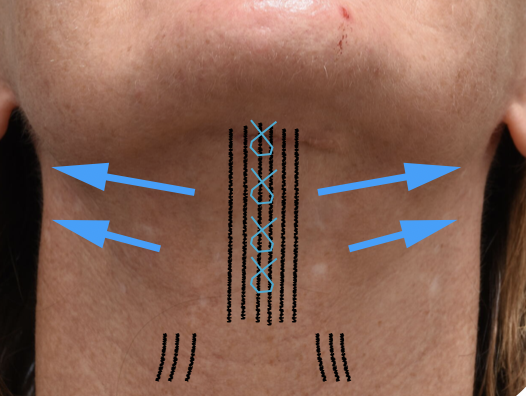
Corset platysmaplasty addresses the muscle directly. Through an incision beneath the chin, the platysma muscle edges are brought together in the midline and secured with sutures, like lacing a corset. Excess fat is usually removed at the same time.
Corset platysmaplasty is commonly combined with a deep plane facelift, because the neck and lower face age together. Tightening the neck muscle without lifting the jowls and lower face can leave the contour looking unbalanced. When performed together, the platysma and the deeper facial tissues are repositioned as a unit, so skin can be redraped with less tension on the incisions.
This is the approach I most often use for patients with visible neck bands, loose skin and a blunted jawline.
Quick comparison
| Submental liposuction | Open defatting | Corset platysmaplasty | |
| Best for | Mild to moderate superficial fat, good skin tone | Moderate fat including deeper fat, good skin tone | Neck bands, loose skin, weak platysma |
| Typical age group | 20-30’s | 20-30’s | late 30’s onwards |
| Treats fat | Yes | Yes | Yes |
| Treats muscle bands | No | Yes – centrally only | Yes |
| Treats loose skin | No | No | Skin is redraped with a facelift |
| Often combined with facelift | Sometimes | Sometimes | Frequently |
Age is a guide, not a rule. Some 35-year-olds have early banding and some 60-year-olds have excellent skin. The decision is made on examination, not on your birth date.
What about non-surgical options?
For very mild fullness, injectable treatments or energy-based skin tightening may be worth discussing. In my experience they are less predictable than surgery and tend to be most effective for patients with minimal change. They are not a substitute for a muscle repair when bands are established.